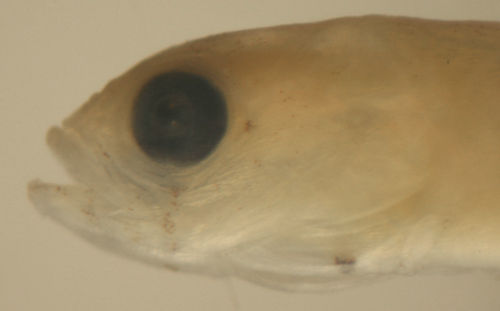
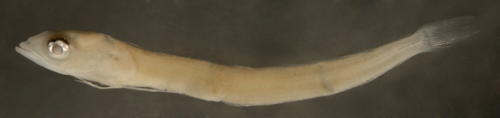
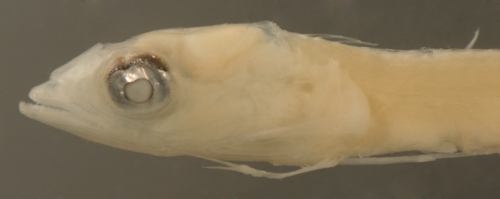
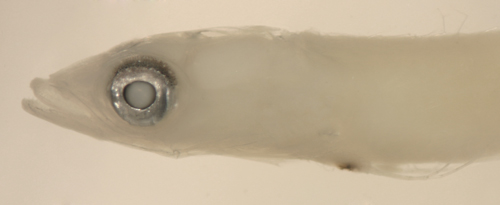
Chaenopsid blennies are tiny fishes and
rarely noticed underwater, yet they are
one of the most speciose families of marine
fishes in the New World. Interestingly,
they are also one of the few marine fish
families to be limited to the Americas.
They have a variety of fanciful common names
including sailfin, flagfin, glass, banner,
secretary, tube, pike, wrasse, and arrow
blennies, among others- few of which are
sufficiently specific. Almost all chaenopsid
blennies are hole-dwelling, often with precise
habitat requirements and sometimes narrow
geographic ranges. They live in most habitats
around Caribbean reefs, including coral
structure, algae, sand, grassbeds, rocks,
tidepools, and pilings. There are numerous
genera and identifications can be difficult.
A number of ill-defined species and species-complexes
with many cryptic species and lineages are
being discovered as DNA-sequencing of the
group progresses. In general, chaenopsid
larvae are not common and mostly undescribed.
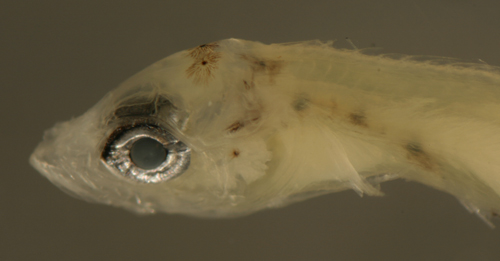
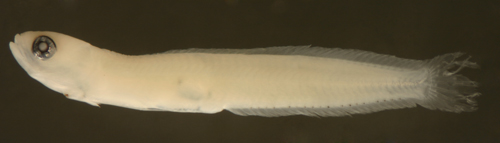
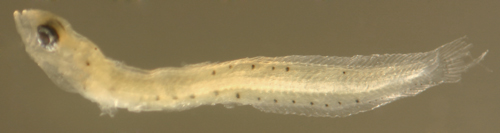
Larval chaenopsids can be recognized by
their long thin body, large round eyes,
a long and continuous dorsal fin with numerous
slender spines and fewer soft rays (in all
but 2 genera), a very short and narrow caudal
peduncle, pelvic fins thoracic (in front
of the pectoral fins) with only 2 or 3 long
strand-like rays (not markedly curled-up
over the body), no head spines, no silvery
peritoneal lining, and light markings. The
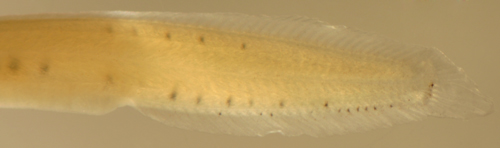
markings vary little and typically consist
of a simple ventral-midline series: around
the isthmus and a row along the base of
the anal fin.
These larval characters are generally shared
with the larvae of the closely related scaled
blennies of the family Labrisomidae,
which well outnumber chaenopsids in most
larval collections. Labrisomid larvae are
very similar to larval chaenopsids and are
distinguished mainly by having fewer dorsal-fin
rays (although there is a small overlap):
regional labrisomids have 12 or fewer dorsal-fin
soft rays (with a rare 13) and fewer than
32 total dorsal-fin elements (with rare
exceptions), while most chaenopsids have
13 or more dorsal-fin soft rays and more
than 32 total dorsal-fin elements. In addition,
labrisomid larvae (other than Starksia)
are larger at the same stage of development,
have additional melanophores, and more procurrent
caudal-fin rays. The Caribbean chaenopsids
with low fin-ray counts that can overlap
with some labrisomids comprise the Emblemariopsis species,
Coralliozetus cardonae, and rarely
Emblemaria
vitta; these larvae can be distinguished
from labrisomids by size, markings, and
lower procurrent caudal-fin ray counts.
The basic taxonomic features separating
the two families, i.e. scales on labrisomids
and scales absent on chaenopsids (along
with a set of osteological characters),
are useless for larval stages.
The distinctive genus Stathmonotus
is still considered chaenopsid even though
their dorsal fin is made up of all spines
(and they can have scales). Some labrisomids
of Paraclinus
also have a dorsal fin made up
of all spines; fortunately the larvae of
the two genera are easily distinguished
by their obvious morphological differences.
Chaenopsid larvae broadly resemble those
of other blennioid families of reef fishes.
They can be distinguished easily from larvae
of the true blennies (family Blenniidae),
which have fewer dorsal-fin spines than
soft rays, blunt snouts at all stages, and
are heavily marked, while larval chaenopsid
blennies have more dorsal-fin spines than
soft rays (except in the snake-like Chaenopsis
and Lucayablennius
zingaro, which still have many more
spines than true blennies), have pointed
snouts (except Stathmonotus),
and are very lightly marked. Larvae of the
blennioid triplefins (family Tripterygiidae)
have three separate dorsal fins and distinctive
melanophores on the dorsal caudal peduncle.
Stargazer larvae (family Dactyloscopidae)
have relatively foreshortened anterior bodies,
curled-up pelvic fins, and very few procurrent
caudal-fin rays.
Larval chaenopsids are superficially similar
to the larvae of gobies
and scarids,
which can have a similar anal-fin row of
melanophores and are the same size as chaenopsid
larvae. However, those larvae notably have
many fewer dorsal-fin spines, short and/or
fused pelvic fins or just stubs, and narrowed
or oddly-shaped eyes, while chaenopsids
have long spinous dorsal fins, large round
eyes, and, at least in later stages, long
thread-like pelvic fins. Larval gerreids
(mojarras) are also common and have an anal-fin
row, however they have silvery abdominal
linings and short dorsal and anal fins.
Larval grunts (Haemulidae) often have an
anal-fin row of melanophores, but they have
spiny heads, short dorsal and anal fins,
and characteristic tail spots.
How to recognize
Chaenopsid larvae
Most chaenopsid larvae are unremarkable
small blennioid larvae with pointed snouts, although
Chaenopsis
larvae are longer and pike-like. Almost all chaenopsid
larvae identified to date have the same limited
pattern of melanophores: a ventral midline series
including one or two around the isthmus and a long
anal row (sometimes extending onto the ventral caudal
peduncle), along with the internal retroperitoneal
(Stathmonotus
hemphilli has additional internal melanophores).
The absence of cranial, nuchal,
cheek, otic, dorsal and caudal-fin melanophores
rules out most other blennioid larvae. The exception
is the labrisomid genus Starksia,
some of whose larvae share the limited melanophore
pattern, but they are easily distinguished by having
many fewer dorsal-fin soft rays (at most 9) and
fewer melanophores in the anal row (fewer than 19
total pvm). Chaenopsid larvae have 3 to 6 procurrent
caudal-fin rays, fewer than the labrisomids Labrisomus
and Malacoctenus
and triplefins Enneanectes,
but overlapping with the labrisomids Starksia
and Paraclinus.
Larval identification
within Chaenopsidae
The chaenopsids have, with few exceptions, relatively
uniform larvae and thus fin-ray counts are needed
for most genus and species identifications by
eye. Although adults can have distinctive morphologies,
especially in the shape and ornamentation of the
head and variously extended fin elements, larvae
are adapted to a pelagic life and do not show
any of these distinguishing features. They are
all slender and have pointed snouts and virtually
all share the basic limited melanophore pattern,
a ventral midline series, until they begin to
develop their species-specific markings during
transition.
Although there are many chaenopsid
genera and a proliferation of species, the family
can be broken down into four basic groups. There
are the tiny and mostly transparent glass blennies
of the Emblemariopsis
group (including Coralliozetus)
that have very small-settling larvae and the lowest
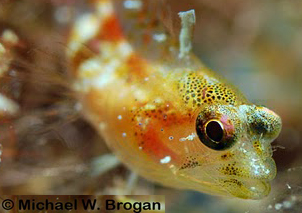
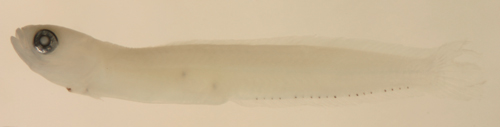
fin-ray counts in the family (E. bottomei,
by Michael Brogan, at left). Their counts overlap
somewhat with the highest-count labrisomids
and the lowest of the Acanthemblemaria
species. The emblemariopsids have only 3 or 4 procurrent
caudal-fin rays (larvae can appear to have 2).
The next group, the sailfin-type blennies of
Emblemaria,
are generally larger and have higher fin-ray counts
than the emblemariopsids.
Most species of Emblemaria
have greatly elongated dorsal fins in both males
and females. The third group comprises Acanthemblemaria,
typically spiny-headed blennies with blunt snouts
and bushy cirri, which are also larger (although
still tiny fishes) and have higher fin-ray counts,
especially of anal-fin rays, and 4-6 procurrent
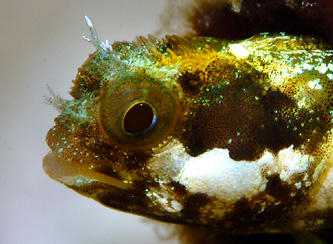
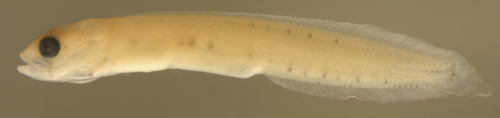
caudal-fin rays (A. maria, secretary blenny,
by Les Wilk, at right). The final group is made
up of the remainder- an eclectic collection of
several genera, mostly monotypic, with longer
eel-like bodies and relatively high fin-ray counts.
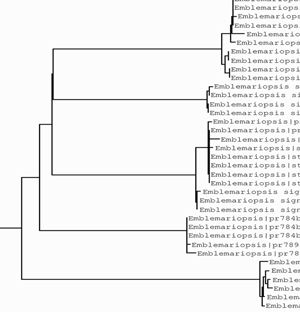
Extensive DNA sequencing
shows many widespread chaenopsid species to
be made up of sets of closely-related species
that can be hard to distinguish, even as adults
(i.e. cryptic species). The chaenopsids, unlike
most other reef fishes, have benthic eggs
and short larval lives which promote reproductive
isolation and genetic divergence within the
region. As a result, there can be a proliferation
of cryptic species and lineages and quite
complex phylogeography. The larvae and juveniles
of many cryptic species would be expected
to be almost identical and are sometimes pooled
into a type for the species complex in the
descriptions below.
Chaenopsid species list
Fin-ray counts: The
taxonomic features used to distinguish chaenopsid genera
are not apparent on larvae. Since fin-ray counts are
one of the few characters that are readily assessed
on larvae and since most related species share counts
to some degree, it is useful to present species in order
of increasing fin-ray counts. The list is in general
order of total dorsal-fin elements, but with genera
and clades grouped together. Note, however, that recent
evidence indicates that local cryptic populations (lineages
or species) can have slightly variant modes and some
counts are based on relatively few specimens.
note: fin-ray counts
in parentheses are ranges, modes (at right) in bold, and
sA is soft anal-fin ray count, two spines not listed.
Chaenopsis stephensi:
mode D-XVII,28-30 sA-30-31 P-13; Venezuela & 275 m
at Arrowsmith Bank off Yucatan
55-57
Emblemariopsis
The genus Emblemariopsis, with the allied Coralliozetus,
includes a growing number of species (and species complexes)
in the tropical western Atlantic, all of whom occupy
small holes among corals and coral rock. These tiny
"glass" blennies are typically transparent
and quite inconspicuous, although territorial males
are black-headed and, in most species, display a red
banner or spike on their dorsal fins. The species are
quite similar in appearance and females and juveniles
can be almost indistinguishable. Most species have orbital
cirri, but one clade does not.
Larvae of Emblemariopsis are small blennioid
larvae with few distinguishing characteristics, other
than reduced procurrent caudal-fin rays (3 or 4, often
only two apparent on larvae). Fin-ray counts are required
for identification by eye: almost all of the species
have fewer dorsal-fin soft rays, anal-fin rays, and
(often) procurrent caudal-fin rays than other chaenopsids.
The low counts in this group typically overlap the labrisomid
blennies of Labrisomus
and Malacoctenus,
but larvae can be quickly distinguished by the reduced
markings on Emblemariopsis larvae (only the ventral
midline series), the few procurrent caudal-fin rays
(3 or 4 vs. 6-10), and the smaller size at similar larval
stages.
There is some overlap in fin-ray counts among Caribbean
Emblemariopsis; some species share counts with
one or several congeners, but often the congeners do
not have overlapping geographic ranges and the process
of elimination can be diagnostic. Unfortunately, some
species complexes are made up of cryptic species with
differing fin-ray counts in various regions, making
it necessary to know the precise locality and the potentially
sympatric congeners to be sure of a species-level identification
(in the absence of a DNA match). Unlike the Acanthemblemaria
and Emblemaria,
the regional species are not yet well worked out and
ranges and species complexes are not resolved. The number
of species of Emblemariopsis at one location
apparently varies from one to five; the maximum number
coexisting at one location is found (thus far) in PR
and the USVI (5), Belize (4 or 5), and Venezuela (4
overall coastline); Florida has only one.
Coralliozetus cardonae
Diagnosis: The
modal fin-ray count of D-XVIII,11 or 12 A-II,18
to 20 P-13 with 29 or 30 total dorsal-fin elements
indicates Coralliozetus cardonae and some
labrisomids of the 18-spined
Labrisomus. Many other Labrisomus
and some Malacoctenus
overlap the fin-ray count, but they are larger
and more heavily marked than Coralliozetus
larvae at comparable stages and have many
more procurrent caudal-fin rays (6-10 vs 3-4).
A rare Emblemariopsis
will share the low fin-ray count with C. cardonae,
but Emblemariopsis
have the first three dorsal-fin spines close together
and a relatively wide gap between the 3rd and
4th spines (vs. normal 3-4 gap). Although C.
cardonae quickly develop a blunt snout after
settlement, the larvae have a pointed snout. (DNA)
Description:
Coralliozetus cardonae
transitional juv
8.6 mm SL, DNA confirmed
ID
Colon, Panama May 29,
2007
Emblemariopsis carib
Diagnosis: The
modal fin-ray count of D-XX,11 A-II,20 P-13 with
31 total dorsal-fin elements indicates the recently-describedEmblemariopsis carib and some labrisomids
of the 20-spined
Labrisomus. The fin-ray count also
broadly overlaps other Emblemariopsis species
in the region. The presence of cryptic species
with differing fin-ray counts in various regions
requires that the precise locality and the fin-ray
counts of sympatric chaenopsids (or DNA sequencing)
be known for species-level identification among
this large group of species. Many other Labrisomus
and Malacoctenus
overlap the fin-ray count, but they are larger
and more heavily marked than Emblemariopsis
larvae at comparable stages, have many more
procurrent caudal-fin rays (6-10 vs 3-4), and
have evenly spaced first dorsal-fin spines (vs.
wide 3-4 gap). (DNA)
Description: Body
long, narrow, and thin with a large round eye,
pointed snout, and medium terminal mouth. Long
continuous dorsal and anal fins with a short and
narrow caudal peduncle. Pectoral fins long, reaching
past the vent, and pelvic fins long and thread-like,
reaching about half-way to the vent. There are
shallow melanophores only along the ventral midline;
one at mid-isthmus and then the anal row starts
at the second spine or first soft ray and marks
the base of each anal-fin ray, followed by a single
small melanophore on the ventral caudal peduncle.
There are 22 total posterior ventral-midline melanophores.
Internal melanophores occur only on the retroperitoneum,
and can extend to the vent and be visible on the
adjacent abdominal wall.
Analogues: The
labrisomids of Starksia
also have only ventral midline melanophores, but
a shorter anal row (18 or fewer total pvm). Other
chaenopsid genera share the limited set of markings,
but have different fin ray counts and relatively
evenly-spaced first four dorsal-fin spines. Among
congeners, E.
ruetzleri larvae can be distinguished
by their 14 pectoral-fin rays.
hvlarv
Emblemariopsis carib
larva,
7.9 mm SL
(1)
Emblemariopsis ruetzleri
Diagnosis:The modal fin-ray count of D-XX,11 or 12
A-II,19 or 20 P-14 with 31 or 32 total dorsal-fin
elements indicates Emblemariopsis ruetzleri
and some labrisomids of the 20-spined
Labrisomus (other Emblemariopsis
overlapping the median-fin-ray count have 13 pectoral-fin
rays). The presence of cryptic species with differing
fin-ray counts in various regions requires that
the precise locality and the fin-ray counts of
sympatric chaenopsids (or DNA sequencing) be known
for species-level identification among this large
group of species. Many other Labrisomus
and Malacoctenus
overlap the fin-ray count, but they are larger
and more heavily marked than Emblemariopsis
larvae at comparable stages, have many more
procurrent caudal-fin rays (6-10 vs 3-4), and
have evenly spaced first dorsal-fin spines (vs.
wide 3-4 gap). (DNA)
Description:
sblarv,rec,n7530 73 rec, pr785 92
Emblemariopsis ruetzleri
larva,
7 mm SL
(San Blas, Panama,
SB86-401)
Emblemaria pandionis
Diagnosis: The
modal fin-ray count of D-XX-XXI,14-16 sA-21-23
P-13 and 34-37 total dorsal-fin elements indicates
the Emblemaria pandionis complex (including
E. caycedoi and E. diphyodontis).
Regional cryptic lineages of the sailfin blenny
have varying modes which overlap the counts for
several other Emblemaria, Acanthemblemaria,
and Emblemariopsis
species. The counts can match A.
spinosa and the A.
aspera complex, however Acanthemblemaria
typically have 23 or more anal-fin rays (and the
A.
aspera complex often have only 12 segmented
caudal-fin rays). The Emblemariopsis
usually have fewer than 14 dorsal-fin soft rays,
but counts can sometimes overlap with E. pandionis
(but 3-4 procurrent caudal-fin rays and a wide
gap between dorsal-fin spines 3 and 4 vs. 4-5
and evenly spaced for E. pandionis). The
presence of cryptic species with differing fin-ray
counts in various regions among all of these chaenopsids
requires that the precise locality and the fin-ray
counts of sympatric chaenopsids (or DNA sequencing)
be known for fin-ray counts to be diagnostic.
(DNA)
Description:
20,14 2,21 VI and Curacao 21,15-16 2,22-23 in
FL Bah PR antig bz 20or21,15 2,22 ut
Emblemaria sp.
larva,
7.9 mm SL
(San Blas, Panama,
SB86-401)
Acanthemblemaria
The genus Acanthemblemaria includes a
number of species and species complexes in the
tropical western Atlantic (and eastern Pacific),
all of whom live in tube-like holes on hard rock
or coral bottoms. They are characterized by blunt
heads with spines and branched cirri over the
eyes, none of which are apparent on larvae. Their
colors and markings are notoriously variable within
species, especially between males and females,
and many species share the basic bars and spot
patterns on the head.
Larvae of Acanthemblemaria have pointed
snouts until transition and morphologically resemble
other blennioid larvae. Fin-ray counts are useful
for identification; most species have more dorsal-fin
soft rays and anal-fin rays than the labrisomid
blennies and the Emblemariopsis
group. The Emblemaria
overlap to some degree, but have 23 or fewer anal-fin
soft rays vs. typically 23 or more in Acanthemblemaria.
Procurrent caudal-fin rays can be helpful: Acanthemblemaria
usually have 4 or 5, two or more fewer than potentially-overlapping
Labrisomus
and Malacoctenus
and one or two more than most Emblemariopsis
and some Emblemaria
(but the same as the E. pandionis group).
There is some degree of overlap in fin-ray counts
among Caribbean Acanthemblemaria species;
most species share counts with two or three congeners,
but often the congeners do not have overlapping
geographic ranges and the process of elimination
can be diagnostic. Unfortunately, some species
complexes are made up of cryptic species with
differing fin-ray counts in various regions, making
it necessary to know the precise locality and
the potentially sympatric congeners to be sure
of a species-level identification (in the absence
of a DNA confirmation). The review by Smith-Vaniz
and Palacio (1974) presents the ranges and fin-ray
counts for many species. Notably, the number of
species of Acanthemblemaria at one location
varies from one to five; the maximum number coexisting
at one location is found in Panama (5; 6 or maybe
7 along the overall coastline), Belize (5), Cuba
and the Bahamas (5), and Venezuela (4 overall
coastline). Florida has only 2 or 3, PR and the
USVI have 3.
Acanthemblemaria rivasi
Diagnosis: The
strong modal fin-ray count of D-XXII,12 or XXI,13
sA-22 P-13 and 34 total dorsal-fin elements indicates
Acanthemblemaria rivasi and some members
of the Emblemariopsis
bahamensis species complex. The low count
of 12 or 13 dorsal-fin soft rays with 21 or more
dorsal-fin spines is restricted to A. rivasi
(S. Caribbean coast), A.
maria (most with 35 or more total dorsal-fin
elements and minimal overlap in geographic range,
in W. Panama, with A. rivasi), A. johnsoni
(Testigos to Tobago only), as well as some Emblemariopsis
species (with only 3 to 4 procurrent caudal-fin
rays vs. 4 to 6 in Acanthemblemaria) and
the labrisomid Labrisomus
filamentosus (with more than 8 procurrent
caudal-fin rays). The fin-ray count barely overlaps
the lowest range for A.
spinosa (but not sympatric, complementary
ranges?) and the Emblemaria
pandionis complex, E. caldwelli,
and Protemblemaria punctata. The labrisomid
Malacoctenus
boehlkei shares the median-fin ray count
but has 15 pectoral-fin rays and more procurrent
caudal-fin rays. (DNA)
Description:
861006 81064 n7531b larv n7527a112 122 n7529b100
Acanthemblemaria
rivasi larva,
mm SL
(San Blas, Panama,
SB86-401)
Acanthemblemaria maria
Diagnosis: The
modal fin-ray count of D-XXII-XXIII,13-14 sA-23-24
P-13 with 35 or 36 total dorsal-fin elements indicates
Acanthemblemaria maria and overlaps several
other Acanthemblemaria and Emblemaria
species. Only a rare A.
spinosa or A.
aspera would reach XXII dorsal-fin spines
and only a rare A. maria would share XXI,14.
The presence of cryptic species with differing
fin-ray counts in various regions requires that
the precise locality and the fin-ray counts of
sympatric chaenopsids (or DNA sequencing) be known
for species-level identification among this large
group of species. (DNA)
Description:
u8630 111
Acanthemblemaria
maria larva,
mm SL
()
Acanthemblemaria spinosa
Diagnosis: The
modal fin-ray count of D-XXI,14-15 sA-23-24 P-13
with 35 or 36 total dorsal-fin elements indicates
Acanthemblemaria spinosa, as well as A.
harpeza (Navassa only), A.
sp. Panama (note that A. spinosa is
not recorded from Navassa or (?) Panama and the
mainland S. American coastline), and the Emblemaria
pandionis complex. The other common species,
the roughhead blenny A.
aspera, is found at most sites with A.
spinosa and frequently has the same fin-ray
counts (but modally one or two more dorsal-fin
soft rays and much longer posterior rays). The
A.
aspera complex, including A.
sp. Panama and (?)A. harpeza, notably
often have 12 instead of 13 segmented caudal-fin
rays. The modal fin-ray count broadly overlaps
the range for some other Acanthemblemaria
and Emblemaria
species, as well as Protemblemaria punctata.
The presence of cryptic species with differing
fin-ray counts in various regions requires that
the precise locality and the fin-ray counts of
sympatric chaenopsids (or DNA sequencing) be known
for species-level identification among this large
group of species. (DNA)
Description:
st951 137 hv08a100 u871u8630u873
Acanthemblemaria
spinosa larva,
mm SL
(
Acanthemblemaria sp.
Pan
Diagnosis: The
strong modal fin-ray count of D-XX-XXI,15 sA-23
P-13 with 35 or 36 total dorsal-fin elements indicates
Acanthemblemaria sp. (Panama), A.
aspera (from Colombia; other populations
have modal 16 dorsal-fin soft rays), and the Emblemaria
pandionis complex, as well as broadly
overlapping the range of A.
spinosa (not found in Panama) and several
other Acanthemblemaria and Emblemaria
species.
The presence of cryptic species with differing
fin-ray counts in various regions requires that
the precise locality and the fin-ray counts of
sympatric chaenopsids (or DNA sequencing) be known
for species-level identification among this large
group of species. (DNA)
Description:
n7527a 92
Acanthemblemaria sp. larva,
9 mm SL
(San Blas, Panama,
SB86-401)
Acanthemblemaria aspera
Diagnosis: The
modal fin-ray count of D-XX-XXI,16 (but often
15) sA-23-24 (22 in Colombia) P-13 with 36 or
37 total dorsal-fin elements indicates Acanthemblemaria
aspera and broadly overlaps the range of many
Acanthemblemaria and Emblemaria
species. The other common species, the spinyhead
blenny A.
spinosa, is found at most sites with A.
aspera (although not along the S. American
mainland from Panama to Venezuela(?)), and frequently
has the same fin-ray counts (but modally one or
two fewer dorsal-fin soft rays and much shorter
posterior rays). In Panama, the closely-related
and sympatric species A.
sp. Panama frequently shares the D-XXI,15
sA-23 fin ray count and can be difficult to distinguish.
Notably, the majority of individuals in the A.
aspera complex (including A. paula
and A.
sp. Panama, but not(?) in the description
of A. harpeza) have only 12 segmented caudal-fin
rays (6+6), instead of the standard 13 (7 dorsal,
6 ventral). The presence of cryptic species with
differing fin-ray counts in various regions requires
that the precise locality and the fin-ray counts
of sympatric chaenopsids (or DNA sequencing) be
known for species-level identification among this
large group of species. (DNA)
Description:
u873 u871
Acanthemblemaria
aspera larva
9 mm SL
(San Blas, Panama,
SB86-401)
Acanthemblemaria betinensis
Diagnosis: The
strong modal fin-ray count of D-XXIII,15 sA-24
P-13 with 38 total dorsal-fin elements indicates
Acanthemblemaria betinensis, endemic to
Panama, Colombia, and Costa Rica. Unlike most
other chaenopsids, A. betinensis frequently
have 6 procurrent caudal-fin rays. Ekemblemaria
nigra is also endemic to the Panama region
and has the same number of total dorsal-fin elements,
but with only XXI spines, as well as 13 pectoral-fin
rays and 4 procurrent caudal-fin rays. A rare
A.
maria would have 15 dorsal-fin soft rays
(and an uncommon A. betinensis would share
14 rays with A.
maria) and rarely A. betinensis
would overlap 22 dorsal-fin spines with A.
aspera (note that many of the latter have
only 12 segmented caudal-fin rays). Several Emblemaria
overlap the lowest range of fin-ray counts for
A. betinenesis. (DNA)
Description:
bet n7529b140
Acanthemblemaria
betinensis transitional
14.0 mm SL, DNA confirmed
ID
Colon, Panama, May
29, 2007
Acanthemblemaria greenfieldi
Diagnosis: The
modal fin-ray count of D-XXII-XXIII,17 sA-27-28
P-13 with 39-40 total dorsal-fin elements indicates
the species complex of Acanthemblemaria greenfieldi, A. chaplini, and A.
cubana. The high anal-fin ray count excludes
all possible relatives, other than A. medusa
from the SE Caribbean, which only rarely has as
many as 39 total dorsal-fin elements. (DNA)
Description:
cn10
bet n7529b140
Acanthemblemaria
greenfieldi larva,
7.9 mm SL
(San Blas, Panama,
SB86-401)
Ekemblemaria nigra
Diagnosis: The
strong modal fin-ray count of D-XXI,17 sA-24 P-14
with 38 total dorsal-fin elements indicates Ekemblemaria
nigra, endemic to Panama and Colombia. The
Acanthemblemaria mostly have fewer dorsal-fin
soft rays; those that reach 17 soft rays have
more anal-fin rays, with the only exceptions an
occasional individual of A.
aspera, a rare A.
spinosa, and a few Emblemaria
pandionis who may reach the lower limit
for E. nigra at D-XXI,16 (but all of the
aforementioned have 13 pectoral-fin rays). Hemiemblemaria
simulus and Protemblemaria punctata
share the 14 pectoral-fin rays but have slightly
fewer anal-fin rays. Some populations of E.
nigra are noted to have frequent individuals
with only 12 segmented caudal-fin rays (like the
A.
aspera complex). (DNA)
Description:
84624a n7 62c
Ekemblemaria nigra
larva,
mm SL
(San Blas, Panama,
SB86-401)
Stathmonotus stahli
Diagnosis: The
modal fin-ray count of D-XLI-XLIII A-II,23-25
indicates either Stathmonotus
stahli or S.
gymnodermis. The two species are morphologically
very similar; adults are easily separated since
S. stahli
have scales and S.
gymnodermis are scaleless. S.
stahli also have the dorsal and anal-fin
membranes merging with the caudal fin about halfway
up the fin vs. only at the base in S.
gymnodermis. Two regional (sub)species
are recognized: S.
stahli tekla west of the Mona Passage (between
Hispaniola and Puerto Rico) including Florida
and the Bahamas across the Western Caribbean down
to Panama and S.
stahli stahli limited to the Lesser Antilles
down to Venezuela (the former with a mode of 11
segmented caudal-fin rays vs. 12 in the latter
(sub)species).
Description: Body
long, narrow, and thin with a particularly small
head, small round eye, small terminal mouth, and
a short pointed snout (becoming more blunted at
transition). Pectoral and pelvic fins very short,
dorsal fin long and continuous with numerous short
spines and anal fin long with numerous short rays,
the membranes merging with the caudal fin well
above the base of the caudal-fin rays. Lightly
marked with melanophores mainly along the ventral
midline: at the isthmus and pelvic-fin insertion
and then along the base of the anal fin, typically
with a melanophore at the base of each anal-fin
soft ray, variably missing a few of the series.
Internal melanophores occur subsurface at the
midline at the rear of the braincase, around the
otic capsule, and along the dorsal aspect of the
swim bladder and around the hindgut near the vent
(often contracted into two spots). ((As transition
approaches two irregular rows of large deep melanophores
develops in the musculature below the dorsal and
anal fins (diff species?)). Series of transitional
larvae show that the eye remains round. Transitional
larvae lose the anal-fin row of melanophores ((starting
at the front and develop a patch of melanophores
at the base of the central caudal fin rays. A
fine uniform speckling appears over the body and
the fins. Patches of fine melanophores develops
on the top of the head and behind the eye and
in a bar below the eye, as well as over the mandibular
and angle of the jaw)).
S. hemphilli is
separated from the other two species by not having
head cirri and having more dorsal spines and fewer
pectoral fin rays (45-53 dorsal spines, 25-31
anal-fin elements and only 4-5 pectoral fin rays).
Stathmonotus
sp. larva,
7.9 mm SL
(San Blas, Panama, SB86-401)
Stathmonotus
sp. transitional larva
7.5 mm SL
(San Blas, Panama,
SB86-729)
Stathmonotus
sp. transitional larva
7.6 mm SL
(San Blas, Panama,
SB86-826)
Chaenopsis limbaughi
Diagnosis: The
modal fin-ray count of D-XVIII-XXI,31-36 sA-34-37
P-12-13 indicates the members of Chaenopsis.
These species share fin ray counts and can be
difficult to distinguish. The primary distinction
is habitat: the common C.
limbaughi is found around reefs and sandy
areas, while C. ocellatus
lives in deeper seagrass beds. C.
resh is a rare deeper-water species found
in