The
true blennies are the unscaled and blunt-nosed
members of the blenniodei, often called combtooth
blennies because of their herbivorous dentation.
Most of the regional blenniids are not reef-associated
but typically occupy rocky shorelines, usually
in the more temperate parts of the region.
The exception is the large redlip blenny,
Ophioblennius
atlanticus macclurei, which is very
common on Caribbean coral reefs.
Larval
true blennies can be recognized by their blunted
snout, long and continuous dorsal and anal
fins with flexible spines, a somewhat short
and narrow caudal peduncle, long strand-like
pelvic fins (usually straight, not curled
up over the body), and relatively heavy markings
(primarily a row of melanophores along the
anal fin base, often along with dense markings
on the pectoral fins and the top of the head).
Many larvae have a prominent preopercular
spine that disappears at transition, although
smaller spines usually remain on the preopercle.
Larval blennioids have large round eyes during
their early life history, in contrast to larval
scarids,
labrids,
and gobies
in which the eye is often small or narrowed.
Among
the closely related families, blenniids can
be separated from the labrisomids,
tripterygiids
and chaenopsids
(other than the easily recognized Chaenopsis
spp.) by the blunt snout and having
fewer dorsal fin spines than rays (except
in Hypsoblennius
invemar), and from dactyloscopids
by having a blunt snout and straight, not
curled, pelvic fins.
Ophioblennius atlanticus
macclurei
Ophioblennius
atlanticus larva
18.9 mm SL
San Blas, Panama, SB86-422
Diagnosis:
A fin ray count of D-XII,19-21 A-II,20-21
indicates Ophioblennius
atlanticus macclurei. Recent phylogenetic
studies (Muss et al. 2001) suggest a split
into five clades in the entire Atlantic, with
genetic divergence on the same order as usually
delineates full species. Thus, the Caribbean
regional form can be considered either a subspecies
of O. atlanticus or its own species,
O. macclurei.
O. atlanticus in Brazil and the eastern
and southern parts of the Atlantic reportedly
have a different fin ray count: D-XII-XIII,21-23
A-II,24. (U)
Analogues:
Description:
Body thick and long with a large eye,
blunted profile, and subterminal
Hypsoblennius invemar
Diagnosis:
A fin ray count of D-XII,11 A-II,13 indicates
Hypsoblennius invemar. This species is the
only Caribbean member of the family with as few
as 11-12 dorsal fin soft rays. The gill slit in
this genus is restricted and does not extend around
the isthmus (true for Hypsoblennius,
Hypleurochilus, and Chasmodes). The
remaining three regional Hypsoblennius
spp. have more median fin rays, 14-16 dorsal
fin soft rays and 14-17 anal fin soft rays:
H. hentz (continental coast US to Yucatan),
H. ionthus from
US waters (Florida and northern Gulf of Mexico),
and H. exstochilus
(from the islands of the northern Caribbean). H.
brevipinnis from the Pacific has recently
invaded through the Panama Canal, and can overlap
the fin ray count of H. invemar.
Analogues:
Description:
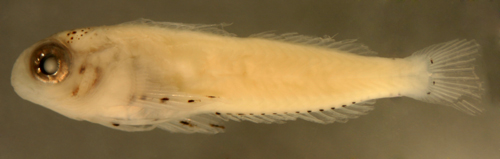
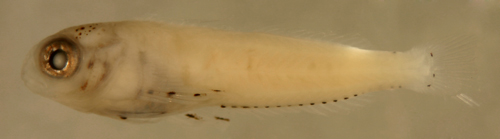
Body thick and long with a large eye, blunted
profile, and subterminal, relatively small mouth.
Pectoral fins long, reaching past the vent, pelvic
fins relatively short. Dorsal and anal fin bases
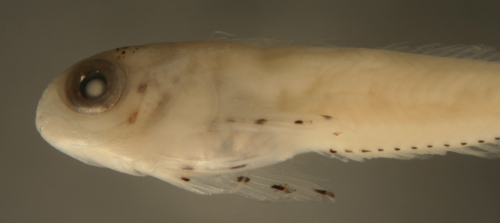
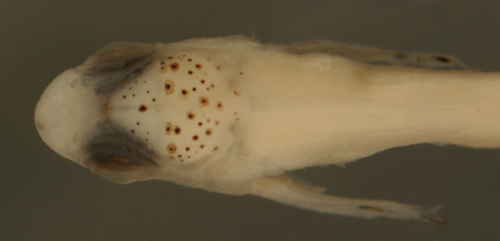
long, caudal peduncle short and narrow. Markings
on the head comprise a large patch of variably-sized
melanophores uniformly speckling the dorsal aspect
of the head, one midline above the tip of the upper
jaw, and two along the margin of the preopercle.
There is a large melanophore on the inner ray of
the pelvic fin not far from the origin and a row
of four or five large melanophores along the longest
lower pectoral fin ray. Along the ventral midline
there is a melanophore at the mid-abdomen and then
a row along the anal fin base (one per soft ray)
continuing onto the caudal peduncle ending at the
start of the accessory caudal fin rays. There are
several melanophores at the base of the segmented
caudal fin rays and one or two on the dorsal midline
of the caudal peduncle. Diffuse internal melanophores
line the abdominal peritoneum.
Hypsoblennius
invemar larva
11.4 mm SL
San Blas, Panama, SB86-422
Hypleurochilus springeri
Diagnosis:
A modal fin ray count of D-XII,13 A-II,15
pect 14 indicates Hypleurochilus
spp. and Lupinoblennius
vinctus. L. vinctus has a gill
slit continuous around the isthmus, separating
it from the Hypleurochilus
spp. and Hypsoblennius
spp. who have restricted gill slits.
There are six regional Hypleurochilus
spp. (sensu Williams in the
FAO book), but only two are widespread in
the Caribbean: H.
springeri and H.
pseudoaequipinnus (= Caribbean H.
aequipinnus). Their modal fin ray counts
are the same, but the latter can often have
14 dorsal fin soft rays and 16 anal fin soft
rays. H. bermudensis
shares the modal fin ray count but is found
in Bermuda, Bahamas, Florida and the Gulf
of Mexico only. The remaining Hypleurochilus
spp. are found in continental US waters
only and have more medial fin rays: H.
multifilis and
H. caudovittatus with 14-15 dorsal
fin soft rays and 16-17 anal fin soft rays
and H. geminatus
with 14-15 dorsal fin soft rays and 17-18
anal fin soft rays.
Diagnosis:
A modal fin ray count of D-XII,13 A-II,15
pect 14 indicates Hypleurochilus
spp. and Lupinoblennius
vinctus. L. vinctus has a gill
slit continuous around the isthmus, separating
it from the Hypleurochilus
spp. and Hypsoblennius
spp. who have restricted gill slits.
There are six regional Hypleurochilus
spp. (sensu Williams in the
FAO book), but only two are widespread in
the Caribbean: H.
pseudoaequipinnus (= Caribbean H.
aequipinnus) and H.
springeri. Their modal fin ray counts
are the same, but H.
pseudoaequipinnus can often have 14
dorsal fin soft rays and 16 anal fin soft
rays. Otherwise, the main feature separating
H. pseudoaequipinnus
from its congeners is the prominent black
spot between the first two dorsal spines.
H. bermudensis
shares the modal fin ray count but is found
in Bermuda, Bahamas, Florida and the Gulf
of Mexico only. The remaining Hypleurochilus
spp. are found in continental US waters
only and have more medial fin rays: H.
multifilis and
H. caudovittatus with 14-15 dorsal
fin soft rays and 16-17 anal fin soft rays
and H. geminatus
with 14-15 dorsal fin soft rays and 17-18
anal fin soft rays.