|
|
|
|
Western Atlantic Coryphopterus
gobies
|
|
|
This large
genus of gobies accounts for the vast majority
of benthic gobies one sees on and around
Caribbean coral reefs. These fishes can
be found perching on the bottom along the
sandy edges of hard substrate, seemingly
everywhere except in the most turbid or
muddy environments. Coryphopterus
contains numerous very similar-appearing
species that can be difficult to distinguish
in the field. Those species that share meristics
can be difficult to identify even when in
the hand or preserved in collections. The
advent of barcoding with mtDNA sequences
allows one to be certain of identifications
and finally permits accurate diagnosis of
indeterminate individuals.On this webpage,
I discuss the features useful for species
IDs of adults, especially since the literature
to date is mostly confusing or incorrect.
|
|
|
Note: Fin ray counts for the second dorsal
fin and the anal fin are total elements (spines
plus rays) and species are listed in rough
order of increasing anal fin rays. |
|
| |
|
|
|
|
|
|
|
|
| The
Coryphopterus spp. in the Caribbean are particularly
difficult to distinguish even as adults. The sand-perching
group, in particular, has been taxonomically troublesome.
The results of my barcode (mtDNA) sequencing for
this group show that the range of variation in morphology
and markings within species is much greater than
is described in the older literature. In addition,
a number of newly-recognized cryptic species are
present within the region. |
|
| One
of the primary causes of the difficulty in identifying
Coryphopterus species in the western Atlantic
is is the extreme variability in the degree of their
dark markings with habitat. All of the sand gobies
have lightly-marked forms on white sand in clear
water and heavily-marked forms on darker sediments
in more turbid waters, particularly along continental
coastlines. This variation can become extreme, with
some individuals showing almost no markings at all.
These occasional super-pallid individuals can be
impossible to identify to species without DNA sequencing.
On the other hand, heavily-marked populations of
some supposedly pallid species, for example Coryphopterus
eidolon, have not been recognized as conspecific
and are typically assigned to other species in museum
collections. |
|
| An
additional problem when using the literature and
field-guides for identifications is the presence
of heretofore cryptic species in the common 10/10
sand-perching bridled-goby group. The traditional
bridled goby, C.
glaucofraenum splits up into a clade of
four different species. Three of these species are
widespread in the region and segregate by habitat
and the other, C.
venezuelae, replaces the others in NE Venezuela,
an unusual region with many endemic reef-fish species.
The recently twice-redescribed "pallid" bridled
goby C.
tortugae and the new more-offshore species
C. bol
(Victor
2008) are presently lumped by most observers
as variants of the bridled goby C.
glaucofraenum. To avoid confusion, I propose
that C.
glaucofraenum retain the original "bridled
goby" common name, while C.
tortugae should be called the "patch-reef
goby" and C.
bol should be called the "sand-canyon goby"
after their distinctive habitats.
|
| |
|
The reported fin ray counts for
the genus Coryphopterus in the literature:
|
|
|
in the order of increasing anal
fin elements, then increasing pectoral fin rays
format= Species: #dorsal/#anal
fin elements #pectoral rays (pelvic fin state)
|
| |
|
fewer than 10 total anal fin
elements
C.
kuna: mode 9/9 pect 15
C.
alloides: mode 10/9 Bohlke:
10, rare 9/9, rare 8 pect 16-17 (divided pelvic
fins)
10/10 group
(total second dorsal and anal
fin elements)
C.
lipernes: Randall: 10/10 pect 16-18 (divided
pelvic fins)
C.
glaucofraenum: Randall: 10/10 pect 17-20
Bohlke: 10/10, rare 9 pect 17-20 usu 19
C.
tortugae: Acero: 10/10 pect 18-20
C. bol:
Victor 2008: 10/10 pect 18-20
C.
eidolon: Randall: 10 (11 was typo)/9-10,
mode 10 pect 19-20, rare 18 Bohlke: 10/10,
rare 9 pect 19-20
C.
thrix: Bohlke: 9-10/10 pect 17-19
C.
dicrus: Randall: 10/10 pect 18-20 Bohlke:
10/10 pect 18-20
10+ group
C. punctipectophorus: Bohlke: 11/10 pect 18-20
(South Carolina to the Gulf of Mexico)
C.
venezuelae: Cervigon: 11/11 pect 18-20
(NE Venezuela: Cubagua, Isla Margarita, and Cumana;
often 12 dorsal and/or anal fin elements)
C.
personatus: divided pelvic fins, Randall:
10-11/10-11 pect 14-16 Bohlke: 10-11, mode
11/10-11, mode 11 pect 14-16
C.
hyalinus: divided pelvic fins, (same as
C.
personatus, although perhaps usu 10/10?)
|
|
|
|
|
|
| Coryphopterus glaucofraenum |
|
|
|
|
|
|
| |
|
|
|
Diagnosis: The
sand gobies are separated by the presence or absence
of a pelvic frenum, the relative length of the
innermost pelvic fin rays, and by markings. In
C. glaucofraenum, the pelvic fin has a
frenum and the innermost pelvic fin rays are about
equal in length to the next ray (slightly shorter
or longer). The bridled goby is one of several
10/10 sand gobies. This species is typically found
in inshore habitats; it accounts for virtually
all the sand gobies in silty mangrove or turbid-water
shallows, many of the sand gobies in shallow bays
with mixed reef/sand habitat, and only occasionally
on offshore patch reefs or deeper habitats. The
suite of markings that identify adult C. glaucofraenum
include
- a two-pronged dorsal projection on the mid-eye
stripe
- two round colon-like spots at the caudal-fin
base (sometimes joined by a constricted bridge
but with the tips distinctly rounded)
- no 8 o'clock oblique bar of melanophores to
the mid-maxilla
- variable markings on the lower pectoral fin
base, usually not a discrete spot
|
|
|
| Coryphopterus
glaucofraenum juvenile |
| 12.9 mm SL |
| San Blas, Panama, SB82-054 |
|
|
|
|
|
|
|
|
|
|
|
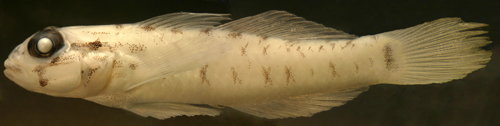
Diagnosis: The
sand gobies are separated by the presence or absence
of a pelvic frenum, the relative length of the
innermost pelvic fin rays, and by markings. In
C. tortugae, the pelvic fin has a frenum
and the innermost pelvic fin rays are about equal
in length to the next ray (slightly shorter or
longer). The patch-reef goby is one of several
10/10 sand gobies. This species is typically found
in shallow patch reef environments; it accounts
for most of the sand gobies on mid-shelf reefs
and around patch reefs in clear water (less than
50 feet deep) and many of the sand gobies in shallow
bays with mixed reef/sand habitat. The suite of
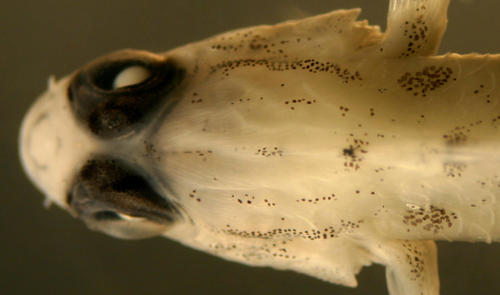
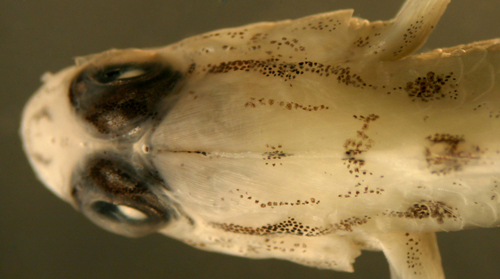
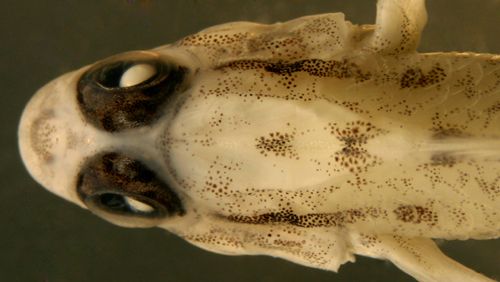
markings that identify adult C. tortugae
include
- triangular dorsal projection (point-up) on
the mid-eye stripe
- broken upper-eye stripe with discrete midline
head spots, no chain-link loops
- no 8 o'clock oblique bar of melanophores to
the mid-maxilla
- no discrete lower pectoral fin base spot
- basicaudal bar, sometimes breaks into two
spots, but not with rounded tips
|
|
|
|
| Coryphopterus
tortugae |
| 36.8 mm SL, DNA confirmed
ID |
| La Parguera, Puerto
Rico pr789 |
|
 |
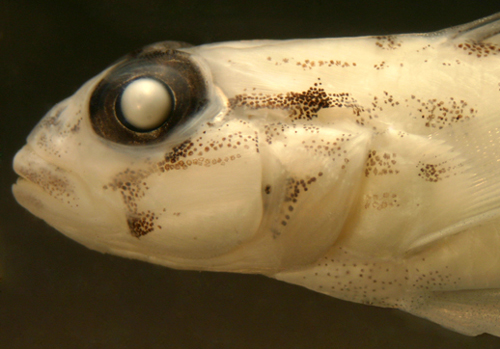
| Coryphopterus
tortugae |
| 36.8 mm SL, DNA confirmed
ID |
no lower pectoral fin
base spot,
broken upper-eye stripe, no 8 o'clock bar |
| La Parguera, Puerto
Rico pr789 |
|
 |
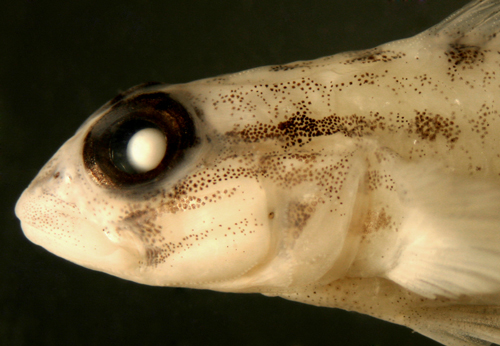
| Coryphopterus
tortugae |
| 32.0 mm SL, DNA confirmed
ID |
heavily-marked form,
with:
no lower pectoral fin base spot,
complete upper-eye stripe but no links,
no 8 o'clock bar from eye, a few speckles |
| La Parguera, Puerto
Rico pr7811 |
|
 |
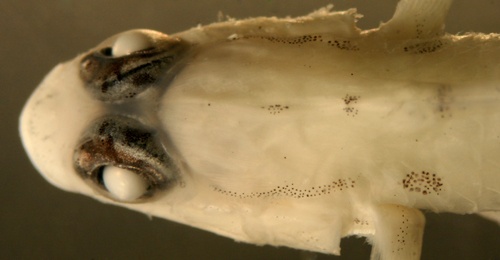
| Coryphopterus
tortugae |
| 27.0 mm SL, DNA confirmed
ID |
| midline spots, no upper-eye
stripe |
| La Parguera, Puerto
Rico pr784b |
|
 |
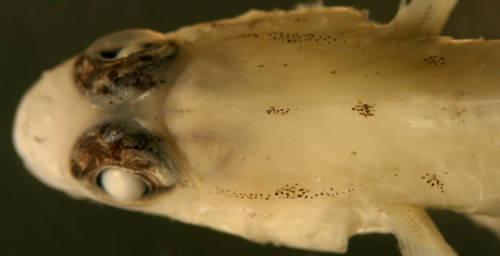
| Coryphopterus
tortugae |
| 28.5 mm SL, DNA confirmed
ID |
| midline spots, broken
upper-eye stripe |
| La Parguera, Puerto
Rico pr784b |
|
 |
| Coryphopterus
tortugae |
| 23.8 mm SL, DNA confirmed
ID |
| midline spots, broken
upper-eye stripe |
| La Parguera, Puerto
Rico pr7811 |
|
 |
| Coryphopterus
tortugae |
| 25.1 mm SL, DNA confirmed
ID |
| midline spots, broken
upper-eye stripe |
| La Parguera, Puerto
Rico pr7811 |
|
 |
| Coryphopterus
tortugae |
| 32.0 mm SL, DNA confirmed
ID |
midline spots, not
clearly linked to
mostly complete upper-eye stripe |
| La Parguera, Puerto
Rico pr7811 |
|
 |
| |
|
|
|
|
|
|
|
|
|
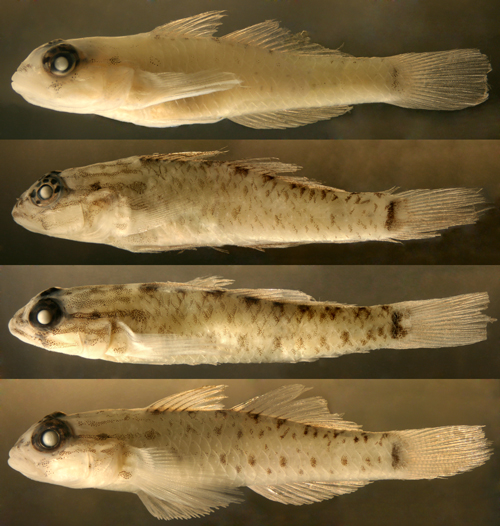
Diagnosis:
The sand gobies are separated by the presence
or absence of a pelvic frenum, the relative length
of the innermost pelvic fin rays, and by markings.
In C. bol, the pelvic fin has a frenum and
the innermost pelvic fin rays are about equal in
length to the next ray (slightly shorter or longer).
The sand-canyon goby is one of several 10/10 sand
gobies. This species is typically found on deeper
offshore reefs; it accounts for most of the sand
gobies in offshore buttress-canyon habitats and
around rocky points with strong currents and is
the main goby found in the sand channels around
dropoffs on continental coastlines with strong currents.
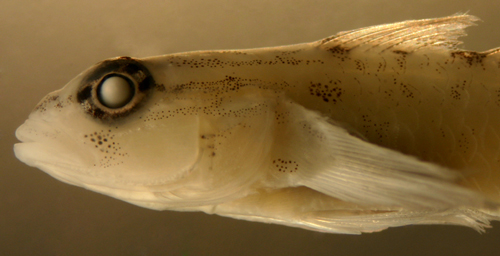
The suite of markings that identify adult C.
bol include
- triangular dorsal projection (point-up) on
the mid-eye stripe
- complete upper-eye stripe with short linear
midline head spots, often connected by loops
of melanophores in a chain-link pattern
- no 8 o'clock oblique bar of melanophores to
the mid-maxilla
- discrete oval lower pectoral fin base spot
- thick C-shaped basicaudal bar in heavily-marked
fish, otherwise variable bar
|
|
|
| Coryphopterus
bol juvenile |
| 22.5 mm SL, DNA confirmed
ID |
| lower pectoral base
spot, complete upper-eye stripe, no 8 o'clock
bar |
| Colon, Panama n7530a |
|
 |
| Coryphopterus
bol holotype and paratypes |
24.5 to 29.0 mm SL, DNA
confirmed ID |
Puerto Rico (top and
bottom)
USVI and Panama (middle two) |
|
 |
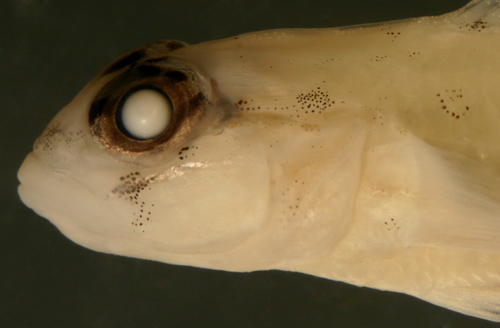
| Coryphopterus
bol holotype |
| 26.8 mm SL, DNA confirmed
ID |
pallid type: few head
melanophores, but
spot developing at lower pectoral fin base |
| La Parguera, Puerto
Rico, pr785a |
|
 |
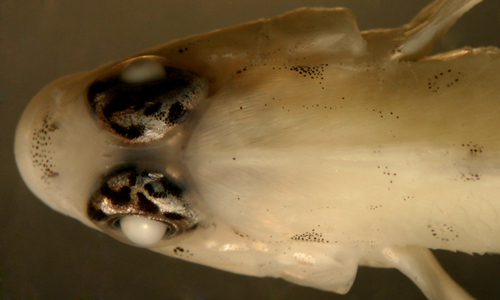
| Coryphopterus
bol holotype |
| 26.8 mm SL, DNA confirmed
ID |
upper-eye stripe developing,
while midline bare |
| La Parguera, Puerto
Rico, pr785a |
|
 |
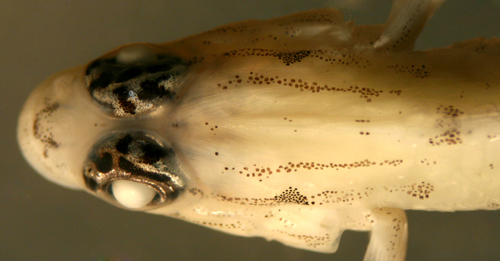
| Coryphopterus
bol |
| 24.5 mm SL, DNA confirmed
ID |
upper-eye stripe complete
midline with only short lines off-center |
| La Parguera, Puerto
Rico, pr785 |
|
 |
| Coryphopterus
bol |
| 23.7 mm SL, DNA confirmed
ID |
upper-eye stripe complete,
fine
loops connecting midline off-center lines |
| La Parguera, Puerto
Rico, pr785 |
|
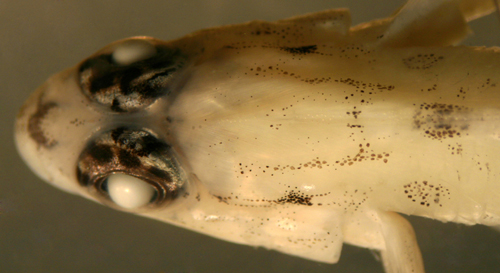 |
| Coryphopterus
bol |
| 32.1 mm SL, DNA confirmed
ID |
upper-eye stripe complete
loops forming chain links |
| La Parguera, Puerto
Rico, pr789 |
|
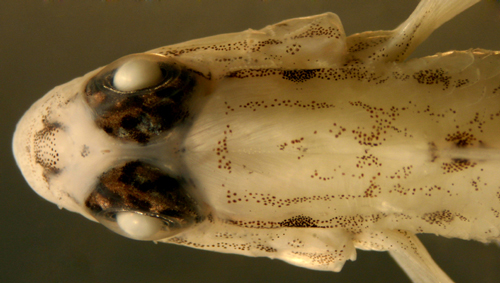 |
| Coryphopterus
bol |
| 22.5 mm SL, DNA confirmed
ID |
upper-eye stripe complete
off-center lyre-like lines starting loops |
| Colon, Panama N7530a |
|
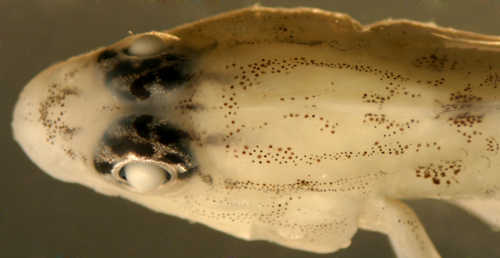 |
| Coryphopterus
bol |
| 28.0 mm SL, DNA confirmed
ID |
upper-eye stripe complete,
connecting
at ends with chain link pattern |
| Colon, Panama N7530a |
|
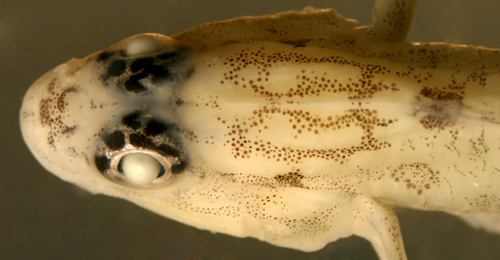 |
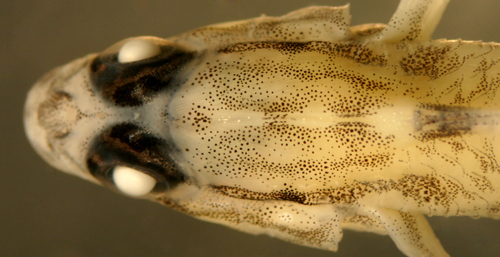
| Coryphopterus
bol |
| 24.5 mm SL, DNA confirmed
ID |
upper-eye stripe complete
full chain link pattern |
| St. Thomas, USVI, 307
|
|
 |
| |
|
|
|
|
|
|
|
|
|
Diagnosis:
The sand gobies are separated by the presence
or absence of a pelvic frenum, the relative length
of the innermost pelvic fin rays, and by markings.
In C. eidolon, the pelvic fin has a frenum
and the innermost pelvic fin rays are distinctly
shorter than the next ray, forming a notched outline
to the rear edge of the pelvic fin. The pallid goby
is one of several 10/10 sand gobies. This species
is typically found in sand channels draining through
the dropoffs in deep clear water without strong
currents. The suite of markings that identify adult
C. eidolon include
- no dorsal projection on the mid-eye stripe
- upper-eye stripe broken at ends, central portion
linear
- 8 o'clock oblique bar of melanophores to the
mid-maxilla
- discrete oval lower pectoral fin base spot
- variable bar of melanophores at the base of
the caudal fin
- sometimes extended second dorsal fin spine
in juvenile
|
|
|
| Coryphopterus
eidolon? |
| 8.3 mm SL |
D-VI,10 A-9 and Pect-19
with anal fin row melanophores |
| San Blas, Panama, SB84-625 |
|
|
| |
|
|
|
|
|
|
|
|
|
Diagnosis:
The sand gobies are separated by the presence
or absence of a pelvic frenum, the relative length
of the innermost pelvic fin rays, and by markings.
In C. thrix, the pelvic fin has a frenum
and the innermost pelvic fin rays are about equal
in length to the next ray (slightly shorter or longer).
The bartail goby is one of several 10/10 sand gobies.
This species is typically found in sand channels
draining through the dropoffs in deep clear water
without strong currents. The suite of markings that
identify adult C. thrix include
- prominent black spot occupying upper half
of pectoral fin base
- small reticulated black spots overlying the
dorsal aspect of the iris
- no dorsal projection on the mid-eye stripe
- upper-eye stripe broken into spots
- 8 o'clock oblique bar of melanophores to the
mid-maxilla
- irregular spot on lower pectoral fin base
- variable short bar of melanophores at the
base of the caudal fin
- often extended second dorsal fin spine
|
|
|
|
| Coryphopterus+
larva |
| 7.7 mm SL |
| speckled membrane above
eye |
| San Blas, Panama, SB86-825 |
|
|
| |
|
| |
|
| |
|
| |
|
|
|
|
|
|
|
|
|
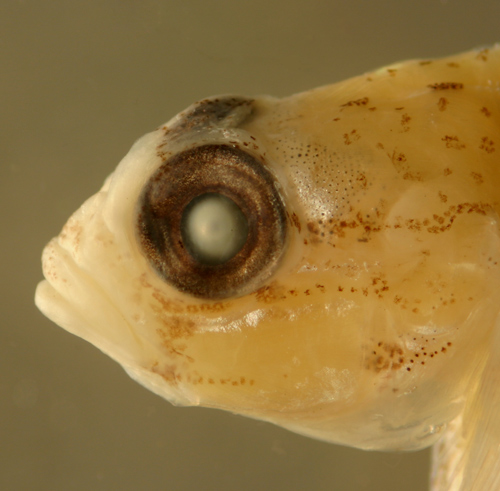
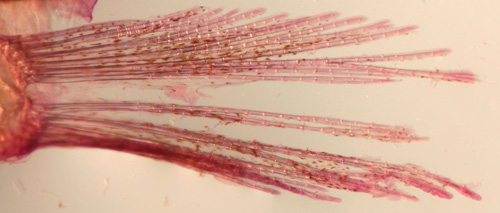
Diagnosis:
The sand gobies are separated by the presence
or absence of a pelvic frenum, the relative length
of the innermost pelvic fin rays, and by markings.
In C. dicrus, the pelvic fin frenum is absent
in large juveniles and adults and the innermost
pelvic fin rays are distinctly shorter than the
next ray. The colon goby is one of several 10/10
sand gobies.The suite of markings that identify
adult C. dicrus include
- prominent round black spot on the upper and
lower third of the pectoral fin base
- wider body with numerous small dark spots
- upper-eye stripe broken into spots
- variable bar of melanophores at the base of
the caudal fin
|
|
|
|
| Coryphopterus
dicrus juvenile |
| 17.0 mm SL |
stripe on lower cheek
and innermost pelvic ray shorter |
| San Blas, Panama, SB83-101 |
|
 |
| |
 |
|
|
|
|
|
|
|
|
| Diagnosis:
The sand gobies are separated by the presence
or absence of a pelvic frenum, the relative length
of the innermost pelvic fin rays, and by markings. |
|
|
Coryphopterus
venezuelae
transitional larva |
| 8.4 mm SL |
a melanophore forward
of the eye
along dorsal fin soft rays (not at base)
no caudal fin melanophores
D-VI,11 A-11 Pect-20 |
| San Blas, Panama, SB86-627a |
|
|
| |
|
|
|
|
|
|
|
|
|
| Diagnosis:
The sand gobies are separated by the presence
or absence of a pelvic frenum, the relative length
of the innermost pelvic fin rays, and by markings.
|
|
|
|
| Coryphopterus
+ larva |
| 7.7 mm SL |
| speckled membrane above
eye |
| San Blas, Panama, SB86-825 |
|
|
| |
|
| |
|
| |
|
| |
|
|
|
|
|
|
|
|
|
|
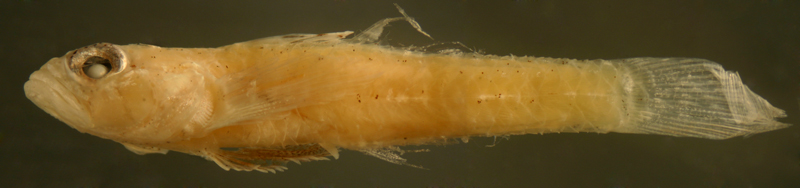
Diagnosis:
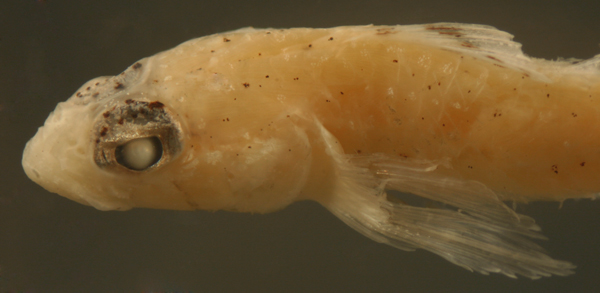
Modal fin ray counts of D-VI,9 A-9 and
Pect-15 indicate the newly-described species Coryphopterus
kuna (Victor
2007), found widely in the Caribbean Sea (thus
far in Yucatan (Banco Chinchorro), Belize, Honduras
(Utila), Panama, San Andres, and Guadeloupe).
|
|
|
|
| Coryphopterus kuna
adult male, |
| 17.6 mm SL |
| San Blas, Panama, SB82-098 |
| |
|
 |
|
 |
|
|
|
|
|
|
|
|
| Diagnosis:
Modal fin ray counts of D-VI,10 A-10 and
Pect-16-18 along with a black ring around the vent
at transition indicates Coryphopterus lipernes.
Although juveniles rapidly acquire divided pelvic
fins, transitional recruits can have fully-fused
pelvic fins. |
|
|
|
|
| Coryphopterus
lipernes + larva |
| 7.7 mm SL |
| speckled membrane above
eye |
| San Blas, Panama, SB86-825 |
|
|
| |
|
| |
|
| |
|
| |
|
|
|
|
|
|
| Coryphopterus personatus
+ |
|
|
|
|
|
|
| |
|
|
| Diagnosis:
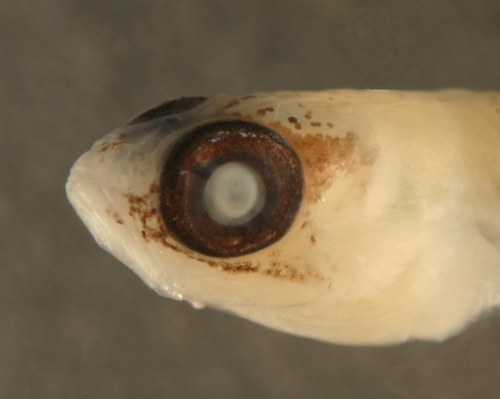
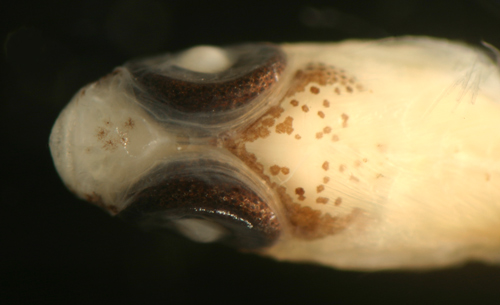
Modal fin ray counts of D-VI,11 A-11 and
Pect-15 indicate Coryphopterus personatus and
the almost identical C. hyalinus. C. personatus
has a single anterior dorsal interorbital pore
while C. hyalinus has two side-by-side, although
the size at which this feature becomes apparent
is unclear. |
|
|
|
| Coryphopterus
personatus juvenile |
| 12.4 mm SL |
| San Blas, Panama, SB82-086 |
|
 |
| |
 |
|
|
|
|
|
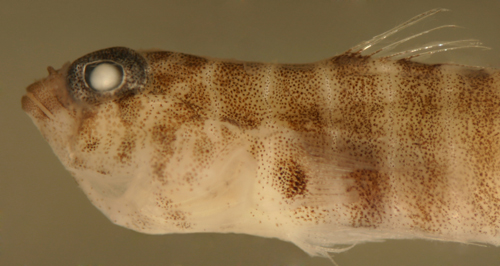
| Diagnosis:
Modal fin ray counts of D-VI,10 A-9 and Pect-15
(often 16) |
|
|
| Lythrypnus
cf nesiotes juvenile |
| 12.4 mm SL |
| does not key to any in Greenfield
1988 |
| Noronha, Brazil, FN-01 |
|
 |
|
|
|
|
|
|
|
| |
|
|
|
|
| |
| |