|
|
|
|
|
| The
damselfishes are some of the most common and conspicuous
coral reef fishes in the region and are often selected
as the subjects for ecological and behavioral studies.
Their taxonomy is straightforward; there are only
four genera in the Caribbean with relatively few
species. Two genera include several species each:
the ubiquitous Stegastes
with six species (and one fresh-water species) and
Chromis
with two shallow and four deep-water species. There
are two Abudefduf
species and the single Microspathodon
chrysurus. The Caribbean Stegastes
have been moved around from genus to genus over
the recent past, spending some time as Eupomacentrus
and Pomacentrus. |
|
| Pomacentrid
larvae closely resemble juvenile damselfish in form
and are easy to recognize. Larval damselfishes are
characterized by a rounded body with a wide caudal
peduncle, continuous spinous and soft dorsal fins,
large round eyes, a relatively small terminal mouth,
and the absence of head spines. Distinguishing species
for the larval and newly-settled stages can be a
challenge in this family where meristics can broadly
overlap, especially within Stegastes.
The marking patterns that separate species of Stegastes
typically diverge only at the late juvenile stage
and new recruits can share many of the features
that will later distinguish the species (i.e. ontogenetic
homology). The two regional Abudefduf
are also very similar as larvae and new recruits.
As a result, some descriptions of damselfish early
life history and many illustrations of small juvenile
damselfishes in guidebooks and on the web are incorrect.
|
|
|
|
|
| |
|
|
|
| The
numerous damselfishes of this genus are known for
marked coloration and pattern changes as they grow,
mostly converging on a uniform dusky appearance
as adults. Pre-transitional larval Stegastes
are mostly colorless with few distinguishing markings
and overlap extensively in meristics and thus DNA
sequencing is necessary to identify many larvae
to species. Damselfish larvae rapidly acquire juvenile
markings during the night of settlement and transitional
larvae are common in collections over the reef,
even before they have the chance to transform in
a trap. |
|
| New
recruits of some Stegastes species can share
the markings that are used as species-specific diagnostic
characters in the later juvenile stages. These shared
markings include the pattern of spots and stripes
on the head, the size, shape, and position of the
dorsal-fin ocellus, the spot at the top of the pectoral-fin
base, and the upper caudal-peduncle saddle-spot.
These characters may not be consistent for identifying
juveniles below 20 mm SL and many species identifications
of photographs of small juveniles on the web and
in reef fish guides are mistaken. Furthermore, the
published descriptions of juveniles of this genus
are almost always incongruent and depend on highly
variable characters, such as shades of yellow or
the degree of striping. The most egregious example
of this is the commonplace assignment of any juvenile
with blue head stripes to S.
diencaeus. |
|
| Transient
ontogenetic homologies in pomacentrid early life
history: This interesting phenomenon of short-lived,
presumably vestigial, markings that appear on early
juveniles is somewhat analogous to the homologies
in ontogeny shown in mammalian embryology. In this
case, however, ontogeny may recapitulate phylogeny
(in a way) as ancestral markings may persist in
the earliest juveniles of an entire clade. The similarity
may extend to the mechanism for the persistence:
just as obsolete embryological structures persist
because of reduced selection pressure within the
womb (for example the hindlimbs in dolphin embryos),
these early markings may persist because of reduced
selection pressure for species recognition among
the smallest juvenile stages on the reef. Alternatively,
a more intriguing explanation may be that this phenomenon
is an adaptation to disguise species identity at
the time of extreme vulnerability to competitive
interactions from adults. |
|
| Species
Identification: Among the larval Stegastes,
S.
partitus diverges first during the transition
phase by not developing the dorsal-fin ocellus shared
by all of the other reef species. The dorsal-fin
ocellus is the first transitional marking appearing
on larvae. Immediately afterwards, the outlines
of iridescent spots and stripes appear on the head
and upper body and the spotted species, S.
adustus and S.
planifrons, can be distinguished from the
striped species, S.
diencaeus, S.
leucostictus, and S.
variabilis. |
|
| New
recruits of S.
partitus share the blue spots and stripes
on the head characteristic of other Stegastes,
although these are usually not conspicuous and disappear
rapidly. Once the dorsal-fin ocellus develops, S.
adustus and S.
planifrons can be distinguished by having
only spots, not stripes, on the top of the head
(as well as other distinctive color patterns). The
three remaining reef species, all with a dorsal-fin
ocellus and stripes on the head, share most basic
markings as new recruits (S.
diencaeus, S.
leucostictus, and S.
variabilis). Nevertheless, with the characters
described below, juveniles of these species should
be categorized correctly. It should be noted, however,
that intermediate individuals do occur. This is
probably variability within species, although the
possibility of occasional hybridization should not
be excluded. DNA-sequencing analyses, underway at
present on this group, will confirm the identification
of larvae and new recruits of these species and
explore the hybridization question further. |
|
| The
most troublesome feature of juvenile markings in
these damselfishes is the rapid change in the size,
shape, and position of the spots, stripes, and the
dorsal-fin ocellus. Overlying these ontogenetic
changes is a high degree of variability within species.
My DNA sequencing of these damselfishes reveals
that many features are inconsistent for separating
species at these early stages, especially the size
and position of the dorsal-fin ocellus and the intensity
of spots on the head and dorsal fin. |
|
|
|
|
|
| |
|
|
|
| Diagnosis:
Damselfishes with 12 dorsal-fin spines and a mode
of 15-16 dorsal-fin soft rays indicate Stegastes
and Microspathodon
chrysurus. Fin-ray counts broadly overlap
among Stegastes
with most species having 13-14 soft anal-fin rays
and 18-20 pectoral-fin rays (S.
adustus and M.
chrysurus have a mode of 21 pectoral-fin
rays). Given this overlap, it is likely that pre-transitional
larvae will require DNA sequencing to reliably distinguish
the species.
|
|
| Early
juvenile markings: New recruits (10-15 mm SL)
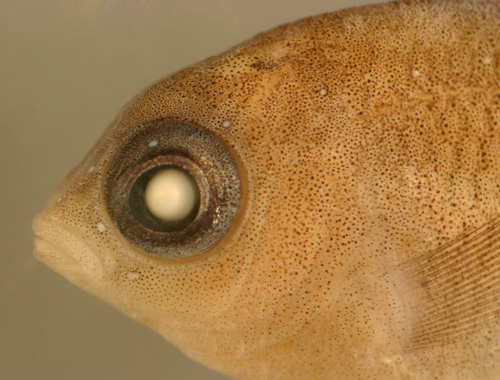
of S. planifrons have only a few discrete
small and round blue spots on the head and upper
body with only a single spot on the upper iris (not
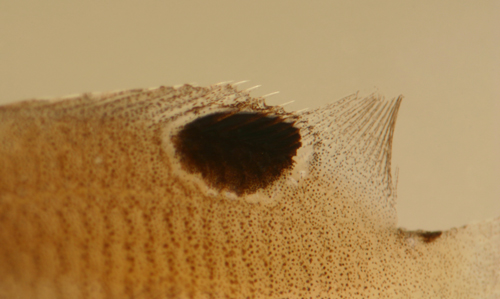
a stripe). There is a large black ocellus centered
on the last three dorsal-fin spines and first three
dorsal-fin soft rays (about 40% on the fin, 60%
on the body) and a caudal-peduncle saddle made up
of a pale area surrounded by dusky shading followed
by a distinct black spot. Although it is a diagnostic
feature for later juveniles, new recruits do not
have a spot at the top of the pectoral-fin base.
Ontogenetic homologies include a short-lived blue
ring around the dorsal-fin ocellus and blue edging
around the caudal-peduncle saddle spot.
|
|
| Juvenile
analogues: New recruits of S. planifrons
are separated from S.
diencaeus,
S. leucostictus, and S.
variabilis by having no stripes on the iris
or the top of the head. In addition, they are uniformly
yellow or dusky yellow (S.
diencaeus is the only other species that
can be uniformly yellow, although often new recruits
are not). New recruits of S. planifrons are
separated from S.
adustus by color as well as having much
smaller blue spots (and only one on the iris) and
from S.
partitus by having a dorsal-fin ocellus
and caudal-peduncle saddle. |
|
| Later
juveniles (over 15 mm SL) are characterized by a
uniform yellow body, a black dorsal-fin ocellus,
a large black upper caudal-peduncle spot, and a
prominent black spot at the pectoral-fin base. |
|
| Description:
|
|
|
|
| Stegastes planifrons
new recruit |
| 10.9 mm SL |
| single spot on iris,
ocellus 40% on the fin |
| Belize, BZ98-704 |
|
 |
| |
 |
|
|
|
|
| |
|
|
|
| Diagnosis:
Damselfishes with 12 dorsal-fin spines and a mode
of 15-16 soft rays indicate Stegastes
and Microspathodon
chrysurus. Although fin-ray counts broadly
overlap among the other Stegastes
with most species having 13-14 soft anal-fin rays
and 18-20 pectoral-fin rays, S.
adustus and M.
chrysurus have a mode of 21 pectoral-fin
rays. The two latter species have a slight divergence
in anal-fin soft rays, with S.
adustus having 13-15, while M.
chrysurus have 12-13. |
|
| Early
juvenile markings: New recruits (10-15 mm SL)
of S. adustus have
|
|
| Juvenile
analogues: New recruits of S. adustus
are separated from S.
diencaeus,
S. leucostictus, and S.
variabilis by having no stripes |
|
| Later
juveniles (over 20 mm SL) are characterized by |
|
| Description:
|
|
|
|
| Stegastes adustus
new recruit |
| 10.9 mm SL |
| Belize, BZ98-704 |
|
|
| |
|
|
|
|
|
| |
|
|
|
| Diagnosis:
Damselfishes with 12 dorsal-fin spines and a mode
of 15-16 soft rays indicate Stegastes
and Microspathodon
chrysurus. Fin-ray counts broadly overlap
among Stegastes
with most species having 13-14 soft anal-fin rays
and 18-20 pectoral-fin rays (S.
adustus and M.
chrysurus have a mode of 21 pectoral-fin
rays). Given this overlap, larvae and even early
juveniles can require DNA sequencing to reliably
distinguish the species.
|
|
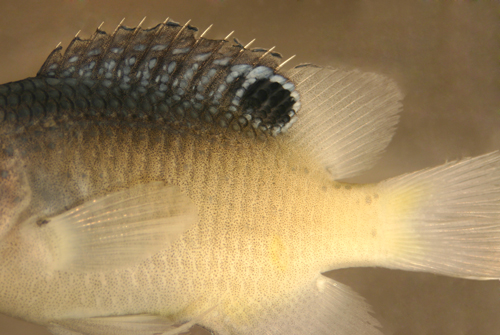
| Early
juvenile markings: New recruits (10-15 mm SL)
of S. leucostictus have a pattern of blue
stripes and spots on the head and upper body with
a broad stripe and two spots on the iris. The upper
part of the head and anterior body have a dusky
blue background color. The blue stripes and spots
are heavier than in other conspecifics and usually
there is a third line of blue spots between the
top stripe on the head and the stripe directly off
the upper eye. Furthermore, the stripes typically
break up into a pattern of numerous bright spots
on the anterior dorsal fin. There is a large black
ocellus ringed in blue centered on the last two
dorsal-fin spines and first three dorsal-fin soft
rays. The ocellus is typically mostly on the fin
(usually 70% or more) and often higher than wide.
There is usually one unmarked scale row between
the lateral line and the blue ring. In addition,
the scales with blue below the ocellus on the body
are darkly-outlined rather than merged into a blue
line. The spot migrates rapidly onto the fin and,
by the time the juveniles reach 20 mm SL, almost
all of the black spot is over the dorsal fin. There
is a dark spot at the top edge of the pectoral-fin
base. There is no caudal-peduncle saddle spot.
|
|
| Juvenile
analogues: New recruits of S. leucostictus
are separated from S.
planifrons and S.
adustus by having stripes along with the
spots on the head and iris and from S.
partitus by having a dorsal-fin ocellus.
The more difficult separation of new recruits (up
to 15 mm SL) from S.
variabilis and S.
diencaeus depends on subtle characters,
primarily the dorsal-fin ocellus centered off the
body, usually more than 70% over the dorsal fin.
In S. leucostictus, there is a space about
one scale wide between the blue ring edge and the
lateral line, while in the other species the blue
ring starts less than a scale above the lateral
line. In addition, the blue ring segment below the
dorsal-fin ocellus is made up of dark-edged scales
in S. leucostictus and merged into a blue
line on the other two species. On the head, the
blue spots usually form a third row between the
top head stripe and the upper-eye stripe, whereas
in the other two species this additional row is
reduced and appears later, after 15 mm SL. S.
leucostictus recruits and juveniles do not have
the caudal-peduncle saddle spot, thus its presence
excludes S. leucostictus (the absence of
the saddle means little in new recruits, when S.
variabilis may not yet have developed a
saddle and when S.
diencaeus variably shows none or a transient
mark). Also S. leucostictus recruits and
juveniles always show the dark spot at the top of
the pectoral fin, thus the absence of the spot excludes
S. leucostictus, but its presence does not
exclude the other species. |
|
|
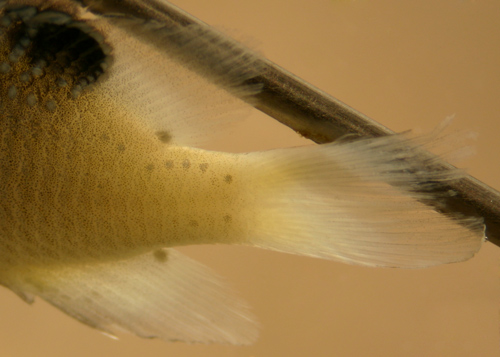
Later juveniles (over 20 mm SL) are yellow with
a blue (often bright blue) upper head and anterior
body and dorsal fin with numerous iridescent blue
stripes and spots, a dorsal-fin ocellus mostly
off of the body (often completely over the fin
rays and subsequently the edges becoming indistinct
and disappearing), a spot at the top of the pectoral-fin
base, and no caudal-peduncle saddle. Some juvenile
damselfishes are identical in all respects to
these S. leucostictus, but do have a caudal-peduncle
saddle, and these are automatically assigned to
S.
variabilis (DNA sequencing should confirm
this conclusion).
|
|
| Description:
|
|
|
|
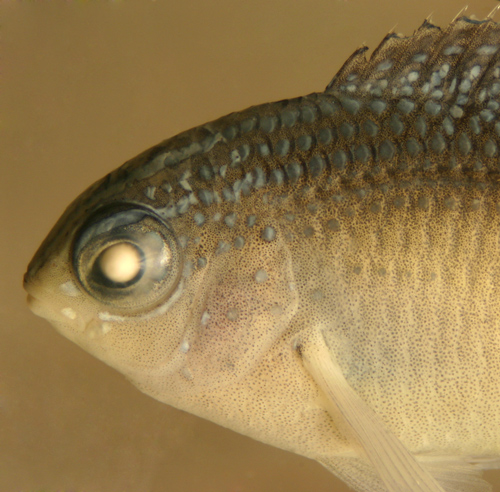
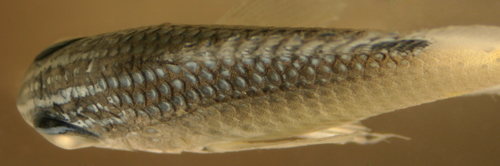
| Stegastes leucostictus
juvenile |
| 21.1 mm SL |
| - three blue stripes
on each side of head |
| -numerous blue spots
on spinous dorsal-fin |
| -ocellus all on the
fin |
| -pectoral-fin base
spot |
| -no caudal-peduncle
saddle spot |
|
| St. Thomas, USVI ,
ST107 |
|
 |
| |
 |
| |
 |
| |
 |
| |
|
|
|
|
|
| |
|
|
|
| Diagnosis:
Damselfishes with 12 dorsal-fin spines and a mode
of 15-16 dorsal-fin soft rays indicate Stegastes
and Microspathodon
chrysurus. Fin-ray counts broadly overlap
among Stegastes
with most species having 13-14 soft anal-fin rays
and 18-20 pectoral-fin rays (S.
adustus and M.
chrysurus have a mode of 21 pectoral-fin
rays). Given this overlap, larvae and even early
juveniles can require DNA sequencing to reliably
distinguish the species.
|
|
| Early
juvenile markings: New recruits (10-15 mm SL)
of S. variabilis have a pattern of blue stripes
and spots on the head and upper body with two spots
and a stripe on the iris. The upper part of the
head and anterior body have a dusky blue background
color. There is a large black ocellus ringed in
blue centered on the last two dorsal-fin spines
and first three dorsal-fin soft rays. The ocellus
is typically 50% on the fin and 50% on the body.
The blue edging below the ocellus on the body is
usually an intact blue line and it comes close to
the lateral line (usually less than one scale away).
There is a characteristic blue-edged black saddle-spot
on the caudal peduncle just behind the last dorsal-fin
ray.
|
|
| Juvenile
analogues: New recruits of S. variabilis
are separated from S.
planifrons and S.
adustus by having stripes along with the
spots on the head and iris and from S.
partitus by having a dorsal-fin ocellus.
New recruits of S. variabilis develop a prominent
caudal-peduncle saddle mark, which serves to distinguish
them from the otherwise very similar S.
leucostictus and S.
diencaeus. Recruits that have not developed
the saddle can be separated from S.
leucostictus by having the ocellus well
onto the body (less useful characters include usually
no additional row of spots between the top stripe
on the head and the upper-eye stripe, and sparser
spotting on the anterior dorsal fin). Early recruits
that have not developed the saddle or have an incipient
saddle are difficult to separate from S.
diencaeus when life colors are not apparent
(S.
diencaeus recruits should not have the anterior
dusky blue wash on the head and upper body and the
stripes are more magenta than blue). The problem
is that some S. variabilis (up to 20 mm SL)
have indistinct caudal-peduncle saddles and many
S.
diencaeus of the same size have similar-appearing
indistinct saddles. In that case, the distinction
becomes more subtle: S. variabilis have more
dusky blue shading over the head and body, especially
including the posterior dorsal fin and the anal
fin while this area is not at all blue in S.
diencaeus. Unfortunately, degrees of duskiness
are poor characters to separate individuals. DNA
sequence comparisons underway at present should
resolve the line of separation. |
|
| Later
juveniles (over 20 mm SL) are are yellow with a
blue (often bright blue) upper head and anterior
body and dorsal fin with numerous iridescent blue
stripes and spots, a dorsal-fin ocellus over the
body and fin (moving off the body when large juveniles
over 30 mm SL), and a prominent black caudal-peduncle
saddle. |
|
| Description:
|
|
|
|
| Stegastes planifrons
new recruit |
| 10.9 mm SL |
| Belize, BZ98-704 |
|
|
| |
|
|
|
|
|
| |
|
|
|
| Diagnosis:
Damselfishes with 12 dorsal-fin spines and a mode
of 15-16 dorsal-fin soft rays indicate Stegastes
and Microspathodon
chrysurus. Fin-ray counts broadly overlap
among Stegastes
with most species having 13-14 soft anal-fin rays
and 18-20 pectoral-fin rays (S.
adustus and M.
chrysurus have a mode of 21 pectoral-fin
rays). Given this overlap, larvae and even early
juveniles can require DNA sequencing to reliably
distinguish the species. |
|
| Early juvenile
markings: This species is distinct in
the field in having magenta stripes
and spots on the head, not strictly blue as
in other juvenile damselfishes. This important
feature is rarely mentioned in books and guides
(in Randall's 2nd edition the |
| stripes
are described as violet, in the 3rd edition
as blue). There are several possible reasons
for this. One is that the difference is sometimes
subtle and affected by lighting. Magenta is
made up of equal parts red and blue, and red
is a color that attenuates rapidly underwater
and thus in deeper water (and in photographs)
the magenta would turn towards blue. Also,
the red color disappears promptly in preservative,
leaving the blue spots and lines indistinguishable
from those on other juvenile damselfishes.
Add to that the relatively low abundance of
the species on many reefs, certainly compared
to the ubiquitous
S. leucostictus and S.
variabilis, and there is ample room
for confusion. The possibility that there
is some variation in the occurrence of magenta
in this species will be explored by DNA sequence
identifications. |

|
|
Photograph by Gregory
Taylor
saltyzoo.com
|
|
|
| New
recruits (10-15 mm SL) of S. diencaeus have
a pattern of magenta stripes and spots on the head
and upper body with two spots and a stripe on the
iris. There is no additional row of spots between
the top stripe on the head and the upper-eye stripe
at this stage (this additional row emerges after
about 15-20 mm SL, often just three spots in a row).
There is a large black ocellus ringed in blue centered
on the last three dorsal-fin spines and first three
dorsal-fin soft rays (about 50% on the fin, 50%
on the body). Although the top of the head and anterior
body may be duskier than the rest of the body in
new recruits, it is not blue. Ontogenetic homologies
include a transient darkening of the scales at the
saddle area of the caudal peduncle, a dark spot
at the top of the pectoral-fin base, and some darkening
of the anterior upper body (but not clearly blue).
|
|
| Juvenile
analogues: New recruits of S. diencaeus
are separated from S.
planifrons and S.
adustus by having stripes along with the
spots on the head and iris and from S.
partitus by having a dorsal-fin ocellus.
New recruits of S. diencaeus are most easily
separated from the other striped species when the
S. diencaeus have no blue wash over the anterior
upper body and head, but some individuals do show
a dusky anterior coloration and these individuals
can be problematic. Other features separating the
new recruits from
S. leucostictus are having the ocellus
half onto the body, the blue ring below the ocellus
a continuous line, no additional row of spots between
the top stripe on the head and the upper-eye stripe,
and sparser spotting on the anterior dorsal fin.
New recruits of S. diencaeus can also be
separated from S.
variabilis by having only a faint caudal-peduncle
saddle (if any) but, when compared to recruits of
S.
variabilis that have not yet developed their
saddle, the distinction is difficult without life
colors. Unfortunately, some S. diencaeus
recruits up to 20 mm SL have some form of faint
caudal-peduncle saddle and some S.
variabilis of the same size can have similar
unformed saddles. In that case, the distinction
can become more subtle: S.
variabilis have more dusky blue shading
over the head and body, especially including the
posterior dorsal fin and the anal fin which are
not dusky in S. diencaeus. Unfortunately,
degrees of duskiness are poor characters to separate
individuals. DNA sequence comparisons underway at
present should resolve the line of separation. |
|
| Later
juveniles (over 20 mm SL) are characterized by magenta
stripes on the head and upper body, a relatively
uniform yellow body (without obviously blue shading
on the anterior upper body and head), a dorsal-fin
ocellus distinctly over both the body and fin, no
caudal-peduncle saddle spot, and no black spot at
the top of the pectoral-fin base. |
|
| Occasional
problematic individuals do have some blue shading
over the top of the head and more than the usual
blue spotting and these may be confused with (or
hybrids of) S.
leucostictus (both species missing the caudal-peduncle
saddle). DNA sequence comparisons underway at present
should resolve the line of separation. |
|
| Description:
|
|
|
|
| Stegastes planifrons
new recruit |
| 10.9 mm SL |
| Belize, BZ98-704 |
|
|
| |
|
|
|
|
|
| |
|
|
|
| Diagnosis:
Damselfishes with 12 dorsal-fin spines and a mode
of 15-16 dorsal-fin soft rays indicate Stegastes
and Microspathodon
chrysurus. Fin-ray counts broadly overlap
among Stegastes
with most species having 13-14 soft anal-fin rays
and 18-20 pectoral-fin rays (S.
adustus and M.
chrysurus have a mode of 21 pectoral-fin
rays). Given this overlap, it is likely that pre-transitional
larvae will require DNA sequencing to reliably distinguish
the species.
|
|
| Early
juvenile markings: New recruits (10-15 mm SL)
of S. partitus have
|
|
| Juvenile
analogues: New recruits of S. partitus
are separated |
|
| Later
juveniles (over 20 mm SL) are characterized by |
|
| Description:
|
|
|
|
| Stegastes planifrons
new recruit |
| 10.9 mm SL |
| Belize, BZ98-704 |
|
|
| |
|
|
|
|
|
| |
|
|
|
| Diagnosis:
Damselfishes with 12 dorsal-fin spines and a mode
of 15-16 dorsal-fin soft rays indicate Stegastes
and Microspathodon chrysurus. Although fin-ray
counts broadly overlap among the other Stegastes
with most species having 13-14 soft anal-fin rays
and 18-20 pectoral-fin rays, S.
adustus and M.
chrysurus have a mode of 21 pectoral-fin
rays. The two latter species have a slight divergence
in anal-fin soft rays, with S.
adustus having 13-15, while M. chrysurus
have 12-13. Late larvae and transitional recruits
of M. chrysurus have the distinctive blackening
of the pectoral-fin rays that confirms the identification.
(ML)
|
|
| Description:
|
| |
|
Microspathodon
chrysurus new recruit, 10.9 mm SL
|
|
|
|
|
| |
|
|
|
| Diagnosis:
Damselfishes with 13 dorsal-fin spines indicate
Abudefduf as
well as the deep-water Chromis enchrysura, C.
insolata, and C. scotti. Abudefduf
saxatilis have a mode of 13 dorsal-fin soft
rays and 12 anal-fin soft rays (D-XIII,13 A-II,11-12
Pect-18-19). A.
taurus have fewer median-fin soft rays,
with a mode of 12 dorsal-fin soft rays and 10 anal-fin
soft rays (D-XIII,12 A-II,10 Pect-18-19). The Chromis
species have modes of 12/11 or 12/12. (ML) |
|
| Description:
|
|
|
|
| Abudefduf saxatilis
transitional recruit, |
| 10.6 mm SL |
| (San Blas, Panama, SB84-523) |
|
|
| |
|
| |
|
| |
|
| |
|
|
|
|
|
| |
|
|
|
|
Diagnosis: Damselfishes
with 13 dorsal-fin spines indicate Abudefduf
as well as the deep-water Chromis enchrysura,
C. insolata, and C. scotti. Abudefduf
taurus have a mode of 12 dorsal-fin soft
rays and 10 anal soft rays (D-XIII,12 A-II,10
Pect-18-19).A.
saxatilis have a mode of 13 dorsal-fin
soft rays and 12 anal-fin soft rays (D-XIII,13
A-II,11-12 Pect-18-19). The Chromis
species have modes of 12/11 or 12/12. (ML)
|
| |
| Description: |
|
|
|
| Abudefduf
taurus transitional recruit, |
| 11.1 mm SL |
| (San Blas, Panama, SB83-137) |
|
|
| |
|
| |
|
| |
|
| |
|
|
|
|
|
| |
|
|
|
| Diagnosis:
Damselfishes (ML)
|
|
| Description:
|
| |
|
Stegastes
planifrons new recruit, 10.9 mm SL 10.9
mm SL
|
|
|
|
 |
|
All contents © copyright 2006-2013
All rights reserved
www.coralreeffish.com by
Benjamin Victor
|
|
|
|
|
|
All contents © copyright 2006-2013
All rights reserved
www.coralreeffish.com by
Benjamin Victor
|
|
|
|
|
|
|